
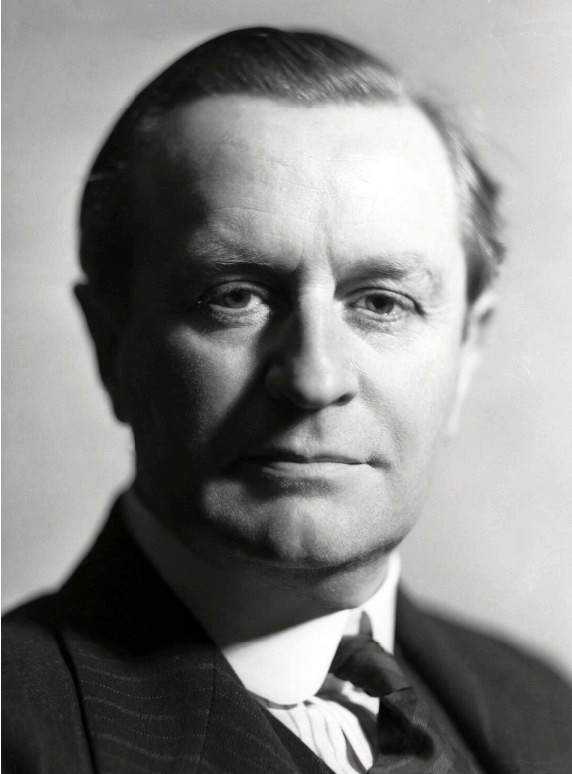
 Questa edizione della Bussola federalista è dedicata a un classico del pensiero federalista: “Il pacifismo non basta” di Philip Kerr (Lord Lothian). Già un paio di frasi che si trovano nelle prime pagine del saggio - “la guerra è un'istituzione che deve e può essere abolita” e, più avanti, “la pace è la creazione di una specifica istituzione politica” - racchiudono il senso di questa riflessione, cioè l’importanza di pensare in termini istituzionali, poiché ogni passo avanti nella direzione della pace e del progresso, se non si consolida in un’istituzione, non è diverso dal masso spinto avanti da Sisifo e sempre destinato a ricadere, per usare la suggestiva metafora dell’autore.
Questo saggio (il cui testo completo è disponibile sul sito https://federalunion.org.uk) è stato scritto in occasione della Burge Memorial Lecture, 28 maggio 1935, e in esso riecheggia infatti l’amara consapevolezza che le speranze di pace che hanno caratterizzato il primo periodo post-bellico sono state tradite e il mondo scivola verso un nuovo conflitto mondiale. Ne resta l’incredibile chiarezza sulla necessaria via da intraprendere per realizzare la pace e un monito per noi tutti.
War is not inevitable. If it comes it will be because humanity has failed to take the steps necessary to end it. What is clear, however, is that the post-war peace movement has failed, so far, to find the way to prevent war. That is why I want today to probe ruthlessly to the real causes of war and to try to set out what I believe to be the only final remedy.
The occasion of war is irrelevant. War is the ultima ratio regum, the legislative instrument whereby issues between sovereign states, which will not yield to voluntary agreement, can alone be settled. [...] Peace is that state of society in which political, economic and social issues are settled by constitutional means under the reign of law, and violence or war between contending individuals, groups, parties, or nations, is prohibited and prevented. Peace, in the political sense of the word, does not just happen. It is the creation of a specific political institution. That institution is the state. The raison d’être for the state is that it is the instrument which enables human beings to end war and bring about change and reform by constitutional and pacific means. [...] Never from the beginning of recorded history nor on any part of the earth’s surface has there been peace except within a state. [...]
The state itself does not eschew violence. On the contrary, it claims that it alone is entitled to use violence. It could not, indeed, exist without the use of violence. [...] In one sense, therefore, the state is violence, but violence only used in accordance with law and, in a democratic and constitutional state, in the interests of the community as a whole and as a result of a decision by a majority of its citizens. [...] In the profound words of Admiral Mahan: “The function of force is to give time for moral ideas to take root”.
It is my purpose today to attempt to establish three propositions. The first is that war is inherent and cannot be prevented in a world of sovereign states. The second is that the League of Nations and the Kellogg Pact, however valuable they may be as intermediate educative steps, cannot end war or preserve civilization or peace. The third is that peace, in the political sense of the word, that is, the ending of war, can only be established by bringing the whole world under the reign of law, through the creation of a world state, and that until we succeed in creating a federal commonwealth of nations, we shall not have laid even the foundation for the ending of the institution of war upon earth.
Nationalism, at bottom, is not race or language or culture, though these are important enough; it is the feeling of common citizenship, common loyalty to the state, buttressed in every possible way by the law, by the omnipotence of the legislative and executive authority, by diplomatic antagonisms with other states, by the duty of every citizen to lay down his life in defence of the state, if it is attacked or its rights impugned. Hence, it is the anarchy of sovereign states, not race or language or culture, which is the dynamic fountain of nationalism, the factor which stresses the separateness of every citizen from his fellow men elsewhere, which encourages him to look at international problems only from his own national point of view to view with fear and suspicion every act by another state which may affect his own state’s security or prosperity.
What is it which has inexorably destroyed the real effectiveness of the League [of Nations] and is ruthlessly wading the world back to armaments, ever-mounting tariffs, poverty and unemployment, power diplomacy and war? The answer is perfectly plain. It is not the malignity of any nation. It is not general international ill-will. These factors exist. But what inflames them all, and is more important than all, is that the Covenant, like the Kellogg Pact, is built on the foundation of the complete sovereignty of the signatory and member states.
[...] Until the peace movement realizes this central fact and base their long distance policy upon it, it will stand in the ranks of those who follow Sisyphus. Every time it succeeds, by immense and consecrated effort, in rolling the stone of national sovereignty near to the top of the hill of international cooperation, it will find that stone slipping out of its control and rushing down to overwhelm its leaders and their followers behind them.
The League [of Nations] is a body incapable either of decision or responsibility. Its meetings may carry moral weight. It may reflect world opinion. But it has none of the attributes of power, either as government, legislature, or court. [...] No nation relies on the League for its security. It relies on nothing less than its own armaments, supplemented if necessary by a military alliance, though that alliance may be disguised in League phraseology. [...] The underlying idea at Paris in 1919 was that the United States, France, and the British Empire should collectively discharge through a League of Nations which gave representation to all peoples, the ultimate stabilizing function which Great Britain alone had performed in the preceding century and in an even more liberal way. The possibility of this kind of stability disappeared with the withdrawal of the United States.
Some form of integration - both economic and political - is bound to come, and if this does not come by voluntary federation it will come by way of empire. The method of empire has been most commonly used to give peace to a distracted world. [...] It is true also that federation is the only lasting method of unity and peace, because it preserves those elements of freedom and justice which are the principle of vitality and growth. [...]
The essence of the federal system, the only true peace system, is the division of governmental power between two organs each responsible to the people for the exercise of the powers in its own sphere and neither having power over or being responsible to the other. [...] The only basis for a peace system is a pooling of sovereignty for supernational purposes, that is the creation of a common nationhood, above but entirely separate from the diverse local nationhoods. To end war the principle of the state - the instrument of peace - must be applied on a worldwide scale.
It is a sobering and a melancholy reflection that twenty years after the outbreak of the world’s greatest war we should once more be drifting back to an alignment making for a repetition of the same kind of struggle but on a vaster and far more devastating scale, because we have been unable to grapple with that anarchy of state sovereignties which is the root cause of war. Is this our only destiny? [...] If another general war broke out, should we fight to perpetuate the anarchy which raised the number of sovereign states in Europe from fifteen to twenty-six and to recreate a League of sixty sovereignties which had conspicuously failed to give us peace? I think not. We should realize that if we were victorious we should have to carry the idea of the Anglo-American Treaty of Guarantee much farther and perpetuate in some form the combination of free peoples which won the war so that world war - if not local war - should be impossible again. And when we began to think in these terms, is it not certain that if we rejected the solution of empire, as we should, we should be driven to consider its only alternative, the solution of federation?
https://en.wikipedia.org/wiki/Philip_Kerr,_11th_Marquess_of_Lothian#


 Iscriviti alla alla



